Where are the superheroes?

I don’t think that I am alone when I say that as a child, I spent a great deal of time either dreaming that I was a superhero or wishing that I had superpowers.  Maybe it was the sign of a troubled childhood and was an expression of a desire to be able to escape my environment and also be able to exact some kind of revenge upon those around me who I felt were less than pleasant.  All you amateur and professional psychologists out there can have a field day on this opportunity for analysis. Up front I would say that you are not entirely wrong if you conclude that all was not completely well at the farm.

Since the introduction of stories from way back when, there has always been this desire to move beyond ourselves.  To be better, stronger, faster, richer, more attractive and the stories, whether written on the page or related orally or pictorially have attempted to convey a world that gives hope.  Whether that ideal has been epitomised in one person or a civilisation, either fully human, demi-god or just god, there is something in us that wants things to be better and to give hope.  When the chips are down, we really want someone or something to come and invade our world and take us out of the circumstances we are in.   

In our modern world, this is no different.  We may have projected this in a different way since the enlightenment in that the personification of hope has moved away from the more ethereal to the rather tangible material ideal, but we still yearn of the same utopian ideal that makes the world better.  For many that can be summed up in the developments that we see in technology.  I have a bit of a problem with this particular solution. Maybe it is because most futurologists seem to predict that this technological utopia will actual end up being the end of us as the introduction of artificial intelligence begins to learn at such an exponential rate that it soon realises how floored we are and decides of its own volition that we are the problem and that the world is a better place without us.  That may be true to some extent, but it denies the possibility that the world was created for us to live in and enjoy, but not to own.

We are custodians. We are meant to be the stewards of our environment awaiting the return of the true landowner.  This is both reassuring and daunting all at the same time. If we are only the stewards, then when the owner returns, what will they find, and will they be pleased about the way we kept their property? That is the daunting prospect.  The reassuring part is that if there is an owner over and above our “paygrade” who wants us to enjoy the bounty of his provision, then there is a strong possibility that he is not going to allow us to be wiped out, even by our own standards of idiocy. After all he owns it all, us included.

Then we have the idea of the “civilisation” that is far more advanced than our own, benevolently looking in on us from the outside and waiting to intervene at the opportune moment so that we do not wipe ourselves out. Remember the 1950’s film “The day the earth stood still” starring Michael Rennie.  Just post WWII and with the proliferation of atomic weapons, the science fiction classic captured the mood of the day and still conveys much of what we are experiencing in our modern society. C.S. Lewis, in his less popular than Narnia series, also captured a great deal of what we see presently in the third book of his science fiction trilogy “That Hideous Strength”.  It even has an organisation called N.I.C.E. A scientific and medical community who existed way before the UK’s National Institute for Clinical Excellence, but in light of the COVID 19 pandemic, eerily accurate in some of its portrayal of how we see government and media in cahoots with each other as they seek to convince the population of how bad or necessary things are in order for us to make it out of the other side. 

So what has all this got to do with superheroes? 

Well, it seems to me that even with all our sophistication, our appetite for heroes and superheroes who can bring a rescue to us is greater than it ever has been.  Maybe it is the ability of the filmmakers, who through the wonders of technology and the green screen have managed to create a world which allows the gods and heroes of Marvel and DC to name but two, to come to life in such a way that we can immerse ourselves in their reality, even though we may have seen New York or some other capital, fictional or otherwise, be destroyed while innocent onlookers run and scream and try to hide from the impending doom that always seems to result from the unveiling of the hidden hero in their midst.  

I recently saw this slogan emblazoned on a building next to a local bakery.
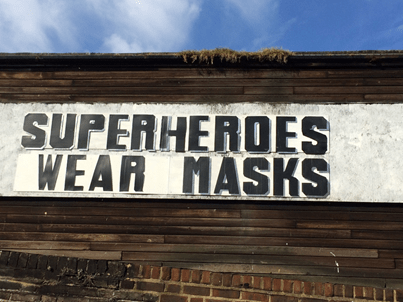
In this instance this was referring to the fact that we have all been instructed to wear masks to protect each other during the pandemic and as time has gone on this has become more and more controversial.  Why? Because, it is not just superheroes who wear masks; it is supervillains too!  In fact we all wear masks in one way or another. Whether it be the mask of virtue so that we can achieve some high office, which once achieved can be discarded, thereby revealing the true intent behind the rhetoric. Or masks of protection, ensuring that we are not giving the unfettered truth in order to protect the ones that we love.

There is a mask that has been worn by “one” for the last nearly six thousand years, by the Hebrew calendar, who from time to time has made an appearance overtly, but covertly has revealed himself on a daily basis.  By the reckoning of the Gregorian calendar, this same “one” made an appearance around two thousand years ago, masked so perfectly, that those who thought they would recognise him when he appeared completely missed it.

Rabbi Yoḥanan says: If you saw a generation whose wisdom and Torah study is steadily diminishing, await the coming of the Messiah, as it is stated: “And the afflicted people You will redeem” (II Samuel 22:28). Rabbi Yoḥanan says: If you saw a generation whose troubles inundate it like a river, await the coming of the Messiah, as it is stated: “When distress will come like a river that the breath of the Lord drives” (Isaiah 59:19). And juxtaposed to it is the verse: “And a redeemer will come to Zion” (Isaiah 59:20). Talmud Sanhedrin 98a

Rabbi Alexandri says: Rabbi Yehoshua ben Levi raises a contradiction between two depictions of the coming of the Messiah. It is written: “There came with the clouds of heaven, one like unto a son of man…and there was given him dominion and glory and a kingdom…his dominion is an everlasting dominion” (Daniel 7:13–14). And it is written: “Behold, your king will come to you; he is just and victorious; lowly and riding upon a donkey and upon a colt, the foal of a donkey” (Zechariah 9:9). Rabbi Alexandri explains: If the Jewish people merit redemption, the Messiah will come in a miraculous manner with the clouds of heaven. If they do not merit redemption, the Messiah will come lowly and riding upon a donkey. (ibid)

Apropos the Messiah, the Gemara asks: What is his name? The school of Rabbi Sheila says: Shiloh is his name, as it is stated: “Until when Shiloh shall come” (Genesis 49:10). The school of Rabbi Yannai says: Yinnon is his name, as it is stated: “May his name endure forever; may his name continue [yinnon] as long as the sun; and may men bless themselves by him” (Psalms 72:17). The school of Rabbi Ḥanina says: Ḥanina is his name, as it is stated: “For I will show you no favor [ḥanina]” (Jeremiah 16:13). And some say that Menaḥem ben Ḥizkiyya is his name, as it is stated: “Because the comforter [menaḥem] that should relieve my soul is far from me” (Lamentations 1:16). And the Rabbis say: The leper of the house of Rabbi Yehuda HaNasi is his name, as it is stated: “Indeed our illnesses he did bear and our pains he endured; yet we did esteem him injured, stricken by God, and afflicted” (Isaiah 53:4). (ibid)

He made Him who knew no sin to be sin on our behalf, so that we might become the righteousness of God in Him. (2 Corinthians 5:21)

Each one of us has the ability to be a superhero. Our superpower is our humanity and our ability to choose to care for each other and for ourselves. If we don’t care for ourselves than it takes far more effort for us to be able to care for others.  If we can be honest with ourselves and step away from the personal aggrandisement that we seek in the name of justice and human rights and humbly achieve these two simple things each day in our environment, whether it be home, work or some other context, we can become the superheroes who seek the well being of each other and in doing so will discover not only our ability to love but also the knowledge that we are loved far beyond anything that we could imagine for ourselves.  Whether you agree with the idea of a Creator who dwells outside of our dimension but has the ability to step into it at any time they please or not, our day to day hope has to be based on our ability to be the superhero in the community around us, because that is truly how the world changes. It has always been this way.  Our greatest superpower is LOVE and the ability to choose LIFE. We don’t need to be Superman to be heroes. Perhaps we can emulate to be Clark Kent and just be there when others need our help.

Don’t lose hope!

In the passages that we are reading this week, we start to see the plan that is set out by GOD in His rescue of the Children of Israel. There are two sides to the story that we see here. The prospect of rescue from the slavery of Egypt has already been expressed to the leaders of the tribes and to Pharaoh. The result has not been positive from the viewpoint of the Israelites. Rather than an easing of work, greater pressure has been applied – bricks without straw, but not a decrease in quota. Not a great outcome if you are thinking about a rescue!

We discover later in the story, that rescue and the unknown can be far less appealing than the seeming creature comforts of slavery when the effort required to commit to a new life are not really established in the hearts of the people but mere words from an external arbitrator.  They require effort and intervention from us, the individual life concerned.

The keys elements to the story before us are the four statements that are made by GOD regarding the rescue. These are the same statements that we proclaim each year at the Passover Seder.

  1. I am the LORD your GOD who will bring you out from under the burdens of the Egyptians.
  2. I will deliver you from bondage.
  3. I will redeem you with an outstretched arm and with great judgments.
  4. I will take you to me for a people and I will be G-D to you. You shall know that I am the LORD your G-D who brought you out from under the burdens of the Egyptians.
  5. I am the LORD you G-D.

From a human viewpoint, and why would you assume that there is any other, these words on the face of it look comforting and helpful; “Yay, the cavalry are coming, a hero comes from over the hill, now we can get back to our normal lives!” 

I think this is much of what people are expressing at the moment in light of the new U.S. administration (although that does not seem to be establishing normality in any obvious way presently), or for some, the hope that the previous administration might return in some form and bring back the former normality.  This is not to ignore the elephant in the room called the pandemic which has turned everyone’s lives upside down.

These are just the things on the macro level.  If we were to drill down to the individual life, we might include elements of bereavement, terminal illness, the list could be endless, but the thing they have in common is that there is no normal that can be returned to.  You have to move forward.  So, presented with the promises above, there also needs to be a recognition that there is a condition involved; If you are going to accept the rescue, then you have to accept the conditions of the rescue. 

It may be that you have to leave a whole lot of things behind you!

But that is not the end of it, because this journey means that we move toward something new and better.  That is why these statements are so key.  

True freedom requires boundaries.  Without them we actually do not feel free.  When you look at the philosophy of socialism attempting to cast off the shackles of capitalism, you only move toward a dictatorship because we all desire the comfort of a leader who will make decisions for us. Essentially a benevolent Father.  I use that term deliberately, because a study of history shows that whatever the religious backdrop, even in communist regimes, the leadership has always perceived itself as the benevolent father/parent, even if in reality the truth on the ground has been to the contrary. 

You might ask, what about countries with female leaders? Well, I don’t think history has been too kind to them either.  In the 70’s and 80’s in the UK when Margaret Thatcher was Prime Minister, she was generally portrayed as the Iron Lady, and parodied as a woman in a suit.  Indira Gandhi, Golda Meir, Aun Sung Suu Kyi; each of these have been pilloried when they have taken strong action in a way that men may not have been criticised so fiercely for or have managed to somehow duck the issue.  You only need to see what is going on in Texas at the moment and consider the response of the present U.S. administration to see that all the prominent voices acclaiming the benevolence of the current conditions seem to be largely female. Even the Vice President has had this issue handed off to her in order that the President has a scapegoat. Meanwhile, many male voices are expressing how inhumane conditions are; but their voices are being drowned out.

So, is this the fault of a patriarchal environment?  Bizarrely, what we see in the U.S. at the moment is that the empowerment of women leaders appears to be encouraging a greater call to militancy and upheaval.  Maybe this is just the result of years of oppression?  Without seeking to make this article a political diatribe, the point I’m attempting to get to is that ultimately, we all desire boundaries, we can’t live with anarchy and disorder. 

“we all desire boundaries, we can’t live with anarchy and disorder”

If you don’t believe that, then try this for an experiment.  Leave the washing up for a month, treating the utensils as disposable as well as the cups, plates, saucers and pans etc.  If you need more you just go out and acquire more for your personal use, nobody will stop you, but you might find the boundaries of your kitchen, house, conscience, starting to scream at you to bring some order back into your life.  It is the way we are wired. Anarchy on any level does not work. Those who advocate it within Christianity, don’t understand their faith. Nowhere does the Bible as a whole advocate lawlessness. It is just individuals looking over the wall in green-eyed envy coveting their neighbour’s goods, wife, belongings, and deciding that they are going to take them no matter what.  Actually, that amounts to theft!

So back to the four statements (or four cups as it is the described in the Passover Seder, which means order by the way) that Moses presents on behalf of GOD to the Children of Israel before their rescue. What is being promised here?  Well, it is freedom! But freedom within a framework of boundaries. 

Freedom to live always exists within a framework of rules. Within the house of the benevolent Father there are rules in order to benefit from the loving rescue that we can experience when we accept the help that comes from his intervention.  But we are not just lifted up and dumped in a wilderness so that we can perish there instead. The reason for the rescue is so that we can be identified as his children and then carry the mantle of his identity into the world showing what it is to be part of the benevolent father’s house.  There may be some disagreements between the siblings, but Father remains the one who will settle those disputes, not the children, until one of those children stands up and takes on the responsibility of implementing the father’s will and purpose in order to show the rest of the family how the father wants things done.  The father will then bestow upon that child the whole responsibility of the rest of the family, warts and all, even to the point of taking the punishment for the family’s misbehaviour because He knows that His child will act in accordance with His will, despite the perceptions of what the other children believe that chosen son will be or do.  How will the rest of the children know that this son is the Anointed One, the Chosen One, the One.  Only from the words of Father’s mouth.

And a voice came out of the cloud, saying,

“This is my Son, my Chosen One; listen to him!”

(Luke 9:35)

What do we need?

2020 was one of the strangest years that we have experienced for many years.  It is rare that the whole world is affected so completely and comprehensively. In fact, it could be said that the last time events were so widespread was probably WWII.  The only difference being with 2020 and as we have stated WWII is that the actual impact of the events in question were blindingly obvious in their origin on the one hand (WW I&II) compared to the endless speculation of the other regarding origin, extent and impact of the pandemic. This is not to say that the pandemic was/is false, but manipulation of events around it are certainly more suspicious then they might be regarding their outcome.

There is a timeless element to all of these events of which we all need to be reminded.  It is not a popular subject for many, but then popularity is not its primary aim.  Even those who would admit to being affiliated to its view of the world might still disagree with the relevance of it when it comes to the detail of everyday life.  The temptation is to mythologise its relevance to our daily lives, but if considered from the point of view of objective truth, then perhaps it is possible to examine the information that it communicates and we might learn something.

What has been is what will be, and what has been done is what will be done, and there is nothing new under the sun. Is there a thing of which it is said, “See, this is new”? It has been already in the ages before us.
(Ecclesiastes 1:9-10)

You don’t need to be a conspiracy theorist or a screaming prophet to realise that something is wrong, but in accordance with the words of the Kohelet (the preacher in the book of Ecclesiastes), this is not new.

So why are we so surprised?

I believe it is because we have become so convinced of our own intellect, that when we look back in history we don’t perceive what we have lost, but rather how much further up the evolutionary ladder we have climbed through science and technology that we must be more enlightened then our forebears. However, once again we can call on history and see that every generation has made this error, looking back and on the one hand appreciating the progress that has been made and “standing on the shoulders of giants” who have led us in this progressive direction while at the same time from the behind the back of our hands smirking and decrying how “ignorant” that previous age was and declaring that we would never make the same mistakes. This present age is the disrespectful teenager who looks at its parents and rolls it eyes, despising how ignorant they are and behind the times in their views.

The Torah teaches that the ten commandments given to Moses were divided evenly between the two tablets of stone, five on the first and five on the second. The first five are understood to be the commandments regarding Man’s relationship to GOD. The second five relate to Man’s relationship to Man. What is interesting about this, if this is the case, is that the first tablet would then conclude with the commandment:

“Honor your father and your mother, that your days may be long in the land that the LORD your God is giving you.” Exo 20:12

So who is my father and mother? Is it just my biological parents? That in itself is a confusing enough question for today. And what does it mean to honour them? Bow down to them? Worship them? And finally, what is this bit about the land that I am being given by GOD? I don’t own any land. This is non-sensical!!!!

The commandment is actually very clear, and a bit mystical all at the same time. Your biological parents are your father and mother, even though science has done so much to make this complicated. Surrogacy is nothing new. It has existed in the ancient world since the beginning which recognised that without children no family, tribe or culture would survive. It is only in our modern society that we have made the child such a disposable commodity, although as the Kohelet says, there is nothing new under the sun and in ancient cultures children were regularly sacrificed before the gods in order to ensure that the adults remained healthy and prosperous. Seems that we are not as sophisticated as we thought. But this is to miss the fact that our ultimate Father is the Creator who brought us into existence and this physical world, the dust that we will ultimately return to is our Mother. We are to honour both in recognising the origin of our existence because by not doing so, our time upon our land or in our land (our physical bodies as well as the land we dwell on) will be foreshortened. This is the first application.

There is a second which is found in the book of Proverbs (Mishlei).

Hear, my son, your father’s instruction, and forsake not your mother’s teaching, for they are a graceful garland for your head and pendants for your neck.
(Proverbs 1:8-9)

The word instruction from the Hebrew is “mussar” meaning “discipline, chastening, correction”. For some, these may connote harshness and not the GOD of the New Testament. Lets clarify that thought.

And have you forgotten the exhortation that addresses you as sons? “My son, do not regard lightly the discipline of the Lord, nor be weary when reproved by him. For the Lord disciplines the one he loves, and chastises every son whom he receives.”
(Hebrews 12:5-6)

If we want to be known as His Children, then a bit of “mussar” can go a long way.

So, what is our mother’s teaching? Well the word used here is probably going to upset some people who might read this but the word used is “Torah”. Indeed, it is the first five books of the bible that is going to get us back on track – assuming that is where we want to be.

Now don’t roll your eyes at me!!! I’m just telling you what Dad said!!

Judgment is more than just intellect

“You shall appoint judges and officers in all your towns that the LORD your God is giving you, according to your tribes, and they shall judge the people with righteous judgment. You shall not pervert justice. You shall not show partiality, and you shall not accept a bribe, for a bribe blinds the eyes of the wise and subverts the cause of the righteous. Justice, and only justice, you shall follow, that you may live and inherit the land that the LORD your God is giving you. (Deuteronomy 16:18-20)

The first judge who was ever appointed on the earth from a biblical viewpoint, whether you believe in the story literally or as an archetype, was Adam. He was given a number of instructions, but when placed in the Garden of Eden, it was in order to “work it” and to “guard it”. The word to “work” in Hebrew is “eved” ‎עֲבֹ֖ד – it can also be translated as “cultivate”. The other element “guard” in Hebrew is “shamar” ‎שָׁמְרָֽ. Both of these words indicate to us that even when we are placed into an idyllic context, there is still work to do and that it is our responsibility to engage in the work; we cannot passively guard or cultivate anything, except perhaps an unhealthy personality. It requires good and sound judgment to cultivate and guard things correctly. As children we are meant to learn this from our parents, teachers and the society that we exist in. The difficulty arises when those elements are in some way bent on an agenda that focuses not on the well-being of the individual within system/society, but upon the individual only existing to benefit the system regardless of the individual; essentially a depiction of Orwell’s 1984.

So what does it mean to “judge”. We are called upon each day and in many ways almost every moment of each day to make judgments of one sort or another. Some of these can seem to be trivial at the time that we do not even give them a second thought, but that is not actually applying sound judgment, in that we also need to assess whether that moment is the first step along a pathway that will lead to harm or whether it is a step toward the good and wellbeing of ourselves, others and our environment (consider this on three levels, personal, local and global). If we go back to the Edenic principle, then we are speaking in terms of guarding and cultivating “good judgment”. The moment by moment judgment can create a cumulative effect that effects our behaviour, opinions and even our physical being. This can be both for the good and for the bad.

Within the daily prayers we recite the following:

Restore our judges as at first, and our counsellors as at the beginning, and remove from us sorrow and sighing.

May You alone, LORD, reign over us soon with loving-kindness and compassion, with righteousness and justice.

Blessed are you, LORD, the King who loves righteousness and justice.

The impression given is that this is something that we are waiting for in the future and when it comes to earthly authorities, it is definitely something that we yearn for today as see those in “authority” over us acting more and more corruptly.  But our Master Yeshua told us that the Kingdom of Heaven is now!!

This then begs the question about the “judgement” that we apply to ourselves and whether we discern correctly and without bias or do we favour our own ends over others?

Here are a couple of verses that illustrate the point.

Here I am; testify against me before the LORD and before his anointed. Whose ox have I taken? Or whose donkey have I taken? Or whom have I defrauded? Whom have I oppressed? Or from whose hand have I taken a bribe to blind my eyes with it? Testify against me and I will restore it to you.” (1 Samuel 12:3)

A bribe is like a magic stone in the eyes of the one who gives it; wherever he turns he prospers.(Proverbs 17:8)

The wicked accepts a bribe in secret to pervert the ways of justice. (Proverbs 17:23)

The point of this illustration is that we are all susceptible to incorrect actions and mis-judgments and I would say that in 99% of those cases it is because there is a bias that we apply in our favour. It is in fact the ultimate expression of freewill.  But the point of this discussion is to recognise that those over us, even though they may be of a greater intellect, do not necessarily act or judge in the best way because of their own personal bias.

We are in a time when we are daily being challenged about what is the best and right course of action, not based in truth and righteous judgement, but political correctness, group think or even just sheer greed. 

The follower of the Master Yeshua is called to operate in the righteousness of the Father and this is also to be done, without bias or self-seeking; it may be hard but it is possible!!!

Teshuvah and Awe (Psalm 27)

During the 40 days from the 1st of Elul to Yom Kippur, Psalm 27 is recited daily.

This is a wonderful Psalm. On this occasion the final line of the psalm stood out for me and it seemed worth sharing.

The Hebrew looks like this:
(Psalms 27:14) קוה אל־יהוה חזק ויאמץ לבך וקוה אל־יהוה׃

Hope to the LORD; Be strong and let your heart take courage; Yes, hope to the LORD.
There is a beautiful symmetry to this final line which is also an encouragement to us. The words at the beginning and end of the line could be regarded as a commandment; they are certainly an instruction for our good.

The English renders this line as: “Hope to GOD”. Personally, I find this a bit “weak”.  
When I think of “hoping in something” it does not necessarily guarantee anything, and even when the object of my hoping is GOD, it can still feel remote because “hope” can be a bit like a shipwrecked sailor hanging on to his bit of wreckage “hoping” that someone sent a distress call before the ship went down and that soon a rescue boat or plane will arrive and collect me out of my “dire straits”. It feels very remote!
But, the word קוה – qaveh is actually much stronger than just “hope”.  
Certainly, the object of our hope “Y-H-V-H” is worth hoping in – but this is calling us to do something far more positive than just “hope”.  It is the essence of “faith”.

Here is the Strong’s definition:
H6960 to bind together (perhaps by twisting), that is, collect; (figuratively) to expect: – gather (together), look, patiently, tarry, wait (for, on, upon).
The call for us is to “bind together” with Him

So, how do we do this? In the centre of the beginning and end phrase calling us to “bind ourselves to Him” are three words.

Strongs# H2388
חזק – chazak to fasten upon; hence to seize, be strong (figuratively courageous, causatively strengthen, cure, help, repair, fortify), obstinate; to bind, restrain, conquer: – aid, amend, X calker, catch, cleave, confirm, be constant, constrain, continue, be of good (take) courage (-ous, -ly), encourage (self), be established, fasten, force, fortify, make hard, harden, help, (lay) hold (fast), lean, maintain, play the man, mend, become (wax) mighty, prevail, be recovered, repair, retain, seize, be (wax) sore, strengten (self), be stout, be (make, shew, wax) strong (-er), be sure, take (hold), be urgent, behave self valiantly, withstand.


This word is generally translated “strengthen”.  It is part of the phrase that is said each time we come to the end of a Torah portion and it is the phrase that is used by Moses and the Children of Israel to encourage Joshua as he begins his time as the leader of Israel.  “Chazak! Chazak! Veneitchazaik! – Be Strong, Be Strong and May we be strengthened!
The next word is: Strongs# H553
אמץ – amatz to be alert, physically (on foot) or mentally (in courage): – confirm, be courageous (of good courage, stedfastly minded, strong, stronger), establish, fortify, harden, increase, prevail, strengthen (self), make strong (obstinate, speed).

The principle thought here is to be resolute and alert!
The third word in the phrase is actually composite: לבך It is translated as “to yourself” but it could also mean “to your heart”. And how are all these connected – by a ו (vav) meaning “and”, but pictorially is a “hook or a nail”. So, we could translate the verse in the following way:
Bind yourself to Y-H-V-H,
Strengthen your heart and He will give you strength/courage/alertness.
Bind yourself to Y-H-V-H

Each morning and evening we say the Sh’ma, which is followed by the words,
“Love the Lord your God with all your heart, with all your soul and with all your might”.
As we continue into the year and this next phase of our lives, continuing up the ladder of soul repair through t’shuva (repentance/return) may we recognise that our only hope is in binding ourselves to Adonai, our Master and our King through Yeshua our Master and Redeemer and the Torah, which Yeshua was the living embodiment of.  Our hope lies in binding ourselves to the Father and all that He has given us.  But we have a task in which we are called to partnership with Him; to resolve and strengthen ourselves for the task ahead, each day, as He lovingly leads us and guides us.

We hereby bind ourselves to the Master, Yeshua the Messiah, The Righteous One, who is the Bread of Life and the True Light, the source of eternal salvation for all those who hear him. Like a branch that remains in a vine, so may we remain in him, just as He also remains in the Father and the Father in him, in order that they may remain in us. And we hereby receive upon ourselves, His yoke to love Adonai Our God with all our heart, with all of our soul and with all of our strength, and to love our neighbour as ourselves.

And may the grace of the Master, Yeshua the Messiah, the love of God and the fellowship of the Holy Spirit abound to us.

Hareini MeKasher used courtesy of First Fruits of Zion.org

Be strong, Be strong, may we be strengthened!!

We have no King!!

The events that we have seen recently in the U.S., particularly in Portland and in Washington DC, are not new phenomena in world history.  They are an inevitable result of the trajectory of empires unless they are drawn into other world changing events such as we saw in WW’s I&II.  The events that we are seeing play out today in the U.S. are more akin to the fall of the Roman Empire, which was not diminished so much by outside forces but rather from within.  An even more apposite example today is found in the Bible, in the books of First and Second Kings and the prophets.

The U.S. is unique in that it was established upon the biblical principles that make up a great deal of its constitution. Incumbent upon this is the obligation to keep these principles at the forefront of its collective “mind” and apply them both societally and individually.  The difficulties begin to arise when this is no longer the prime objective.  It is at this point that the system begins to crumble and the ensuing administrations see each opportunity for power not as a continuation of the “building of the tower upward” but rather to remove the previous administration’s efforts.  The result of this is not just a stultification of growth, but a diminishment of the overall structure, resulting in the observation by those outside looking in, that the once noble structure is now falling apart as infighting continues. This of course misses the point that any “democratic republic” is founded on: the collective co-operation and goodwill of its citizens who, if they become disenfranchised, begin to fragment and establish a self-rule and protectionist mindset that further undermines the ability of the elected authorities to govern.  This then leads to totalitarianism that removes all individual freedoms apart from those that “agree” with the governing body.

The book of Hosea speaks in particular to the northern kingdom of Israel, known biblically as Ephraim or Israel, (as opposed to the southern region known as Judah, which itself was focussed primarily around Jerusalem and included the tribal land allocation of Benjamin) and at a time when Israel is about to be taken into captivity, historically known as the Assyrian exile.

Prior to this, the prophet Hoshea (his Hebrew name meaning “salvation”) is called by GOD to bring a message, warning in advance of what is about to take place because of the refusal of the northern kingdom to cease worship of the false gods of the surrounding nations and to “return” (“shuv” in Hebrew, which in most bibles is translated “repent”) to the worship of the GOD of Abraham, Isaac and Jacob. However, within the understanding of this is embedded the idea that the GOD of Israel is not just “GOD”, but that He is also their King. The fact that they have already rejected this principal idea (see 1 Samuel 8) is at the root of the problems that they find themselves in just prior to the Assyrian exile.

In Hoshea 10:3 Israel expresses the following sentiment:

For now they will say: “We have no king, for we do not fear the LORD; and a king—what could he do for us?”
(Hosea 10:3)

The final part of this verse “what could he do for us?” can also be translated “what could he do to us?” This is not an expression of concern, but an expression of arrogance and lawlessness; much the same as we are seeing in the cities of Portland, Seattle and Washington DC.  It is not the expression of religious conservatism, but the lawlessness of anarchic totalitarianism born out of socialism akin to what was seen in Germany leading to WWII.

At the basic level, fear of GOD instils in us a recognition that there is an ultimate authority to whom we are responsible.  If, in the hierarchy of things, we believe that the gods that we worship are powerless and only a figment of our own imaginations, then the power that they have over us has to be of some temporal, man-made form, whether that be a king (as in Israel’s case) or a governing authority as we see in the modern hierarchies that are our present system.  No matter what the case, systematically, as regimes become more corrupt, our society and our own natures can become corrupted too. The rationalisation of events and actions is framed and established in the belief that as there is no ultimate authority, as long as we abide by the governing rules and colour within the lines, then all will be well. However, those who are less “conservative” about what those lines are will push the boundaries, not necessarily to be wholly lawless, but lawless enough to manipulate the system to their own ends, even at the cost of others.  The situation becomes more acute when the “fear of GOD” is so diminished that neither is there fear of earthly authority, kings and/or government . This results in the conclusion that the only authority worth listening to is that of the “pack”, “group-think”, or the individual’s own morality, which is informed primarily by the actions of others and their own ego.

Essentially this undermining of authority is the undermining of the two golden rules of Judaism and early Christianity, which in essence is Messianic Judaism based on the principle of Yeshua (whose name means GOD is salvation) as Messiah.

  1. LOVE THE LORD YOUR GOD WITH ALL YOUR HEART, SOUL, MIND AND STRENGTH
  2. LOVE YOUR NEIGHBOUR AS YOURSELF

Without these two governing principles at the core of our actions lawlessness in one form or another will ensue.  Those who choose lawlessness will only be informed by the moral relativism which is short term and initially appears to be fit for purpose, but ultimately runs its course and the societal pulse spirals downwards as the governing law of the second rule of thermodynamics dictates.