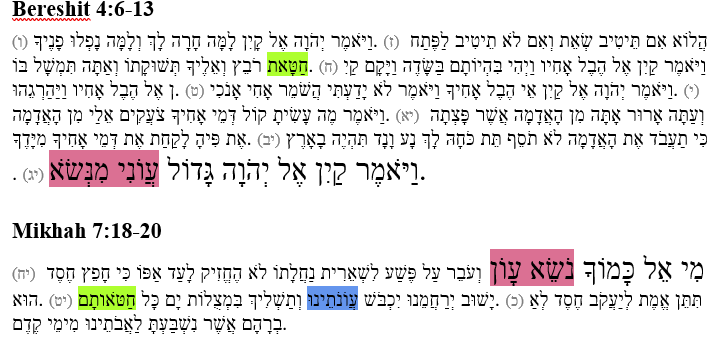
Who is a God like you, pardoning iniquity and passing over transgression for the remnant of his inheritance? He does not retain his anger forever, because he delights in steadfast love. He will again have compassion on us; he will tread our iniquities underfoot. You will cast all our sins into the depths of the sea. You will show faithfulness to Jacob and steadfast love to Abraham, as you have sworn to our fathers from the days of old. (Micah 7:18-20)
The Tenth Attribute – Give Truth to Yaakov
The Sages seem to approach this attribute in two ways.
In the first instance it looks to be a plea to the Holy One that He will fulfill His promise to Jacob; that despite all of the errors that Israel as a people have made and are now going into exile, here is an express declaration of the faithfulness of the Father to maintain the faithfulness of the promise made to Abraham, Isaac and Jacob. To emphasise this, I have listed some of the scripture which sets out the promises made specifically to Abraham, Isaac and Jacob. it is not an extensive list, but it gives a flavour of the importance of understanding the foundation of the promises made and the necessity of their fulfillment if truth is to be established.
I will make of you a great nation, I will bless you, and I will make your name great; and you are to be a blessing. I will bless those who bless you, but I will curse anyone who curses you; and by you all the families of the earth will be blessed.” Genesis 12:2-3
Adonai appeared to Avram and said, “To your descendants I will give this land.” So he built an altar there to Adonai, who had appeared to him. Genesis 12:7
Adonai said to Avram, after Lot had moved away from him, “Look all around you from where you are, to the north, the south, the east and the west. All the land you see I will give to you and your descendants forever, and I will make your descendants as numerous as the specks of dust on the earth — so that if a person can count the specks of dust on the earth, then your descendants can be counted. Get up and walk through the length and breadth of the land, because I will give it to you.” Genesis 13:14-17
Some time later the word of Adonai came to Avram in a vision: “Don’t be afraid, Avram. I am your protector; your reward will be very great.” Genesis 15:1
On that day the LORD made a covenant with Abram, saying, “To your offspring I give this land, from the river of Egypt to the great river, the river Euphrates, the land of the Kenites, the Kenizzites, the Kadmonites, the Hittites, the Perizzites, the Rephaim, the Amorites, the Canaanites, the Girgashites and the Jebusites.” Genesis 15:18-21
“By myself I have sworn, declares the LORD, because you have done this and have not withheld your son, your only son, I will surely bless you, and I will surely multiply your offspring as the stars of heaven and as the sand that is on the seashore. And your offspring shall possess the gate of his enemies, and in your offspring shall all the nations of the earth be blessed, because you have obeyed my voice.” Genesis 22:16-18
And he said, “O LORD, God of my master Abraham, please grant me success today and show steadfast love to my master Abraham. Behold, I am standing by the spring of water, and the daughters of the men of the city are coming out to draw water. Let the young woman to whom I shall say, ‘Please let down your jar that I may drink,’ and who shall say, ‘Drink, and I will water your camels’—let her be the one whom you have appointed for your servant Isaac. By this I shall know that you have shown steadfast love to my master.” Before he had finished speaking, behold, Rebekah, who was born to Bethuel the son of Milcah, the wife of Nahor, Abraham’s brother, came out with her water jar on her shoulder. Genesis 24:12-15
And the LORD said to her, “Two nations are in your womb, and two peoples from within you shall be divided; the one shall be stronger than the other, the older shall serve the younger.” Genesis 25:23
And the LORD appeared to him and said, “Do not go down to Egypt; dwell in the land of which I shall tell you. Sojourn in this land, and I will be with you and will bless you, for to you and to your offspring I will give all these lands, and I will establish the oath that I swore to Abraham your father. I will multiply your offspring as the stars of heaven and will give to your offspring all these lands. And in your offspring all the nations of the earth shall be blessed, because Abraham obeyed my voice and kept my charge, my commandments, my statutes, and my laws.” Genesis 26:2-5
And he came to a certain place and stayed there that night, because the sun had set. Taking one of the stones of the place, he put it under his head and lay down in that place to sleep. And he dreamed, and behold, there was a ladder set up on the earth, and the top of it reached to heaven. And behold, the angels of God were ascending and descending on it! And behold, the LORD stood above it and said, “I am the LORD, the God of Abraham your father and the God of Isaac. The land on which you lie I will give to you and to your offspring. Your offspring shall be like the dust of the earth, and you shall spread abroad to the west and to the east and to the north and to the south, and in you and your offspring shall all the families of the earth be blessed. Behold, I am with you and will keep you wherever you go and will bring you back to this land. For I will not leave you until I have done what I have promised you.” Genesis 28:11-15
And God said to him, “Your name is Jacob; no longer shall your name be called Jacob, but Israel shall be your name.” So he called his name Israel. And God said to him, “I am God Almighty: be fruitful and multiply. A nation and a company of nations shall come from you, and kings shall come from your own body. The land that I gave to Abraham and Isaac I will give to you, and I will give the land to your offspring after you.” Genesis 35:10-12
The verses above are foundational in their expression of the covenant that the Father has made with the offspring of Abraham, Isaac and Jacob. This is the appeal that is being made in these final verses of Micah; that the Holy One would not relent or renege on these promises. In His full knowledge of the flawed nature of men, He spoke these words, not in a moment of wishful thinking.
Torah’s instruction -v- Our flawed nature
As we have discussed previously, Torah’s instruction is not diminished by our in ability of fulfill it. As a standard set out for life, whether we are able to maintain living in accordance with its instructions or not, it remains the expression of the Father’s heart setting forth the true desire of what “utopia” might look like. Our aversion to its instruction is rooted in the disobedience in the Garden founded in the statement “has God said”. The reaction to that we have in seeking to “interpret correctly” what Father is setting out, has over time created the works of many writers and the Sages to interpret and instruct; it is the basis of the Oral Torah interpretations, which are elaborations on the rulings of the Written Torah. Keeping in mind these principles, we find that the wide-ranging interpretations should not stand as their own authority. The difficulty that we encounter is the way that scripture can be taken out of context or used to create a precedent of understanding that is not in keeping with the original intention of the “Author” or the text. This has manifest itself in many ways, its most potent form being antisemitism and replacement theology. To investigate these further is beyond the scope of this study, but the phrases “You will show faithfulness to Jacob” and “Give Truth to Yaakov” override the ultimate impact that they espouse to have in the ultimate conclusion of history. However, what they do show is either a willful ignorance of the truth of the scripture by those who have studied it carefully, or a rampant manifestation of hatred and jealousy toward the Creator and the people that He chose as His inheritance.
Give Truth to Yaakov
The second approach that the sages take, which is evidenced in Tomer Devorah is that of the difference between and attitude of legalistic understanding of the Torah, which can be life sapping, rather than the correct instruction of Torah applied with mercy and compassion which can be life giving.
As we investigate this idea, we discover that one of the hardest sections of scripture to understand in the gospel accounts is explained by correctly applying the 10th attribute.
“Don’t think that I have come to abolish the Torah or the Prophets. I have come not to abolish but to complete. Yes indeed! I tell you that until heaven and earth pass away, not so much as a yud ( י ) or a stroke will pass from the Torah — not until everything that must happen has happened. So whoever disobeys the least of these mitzvot and teaches others to do so will be called the least in the Kingdom of Heaven. But whoever obeys them and so teaches will be called great in the Kingdom of Heaven. For I tell you that unless your righteousness is far greater than that of the Torah-teachers and Pharisees, you will certainly not enter the Kingdom of Heaven! Matthew 5:17-20
We are familiar with the first part of this section of Matthew 5, but it is the final part that we are most interested in this study. When we first came to faith in Yeshua as our saviour, it may well be that our initial experience was one of such joy that our desire was to get to know our redeemer better through the word of the scripture. We were hungry for a relationship with the Living God and to understand our place in all of this. But as we have grown in our knowledge of Torah, it may well be that we have become more exacting not just in our own behaviour, but in what we see in others. When Yeshua speaks of how our righteousness is to exceed that of the Pharisees, we recognise that their “understanding” of the Law was of such a high standard that it created a spirit of such superiority that it caused a haughtiness within them that they began to look down upon people as those who were failing to keep Torah as well as they did. The result of this caused an alienation from the true purpose of Torah. We have perhaps begun to do the same thing. To exceed the righteousness of the Pharisees is not to become more pious, but to become more merciful. Not to become tolerant of sin and wickedness, but to certainly not look down on others who do not believe in the same way we do to recognise as scripture says that we were saved while we were still transgressors of the will of the Father.
The explanation comes in the phrase to “Give Truth to Yaakov”. How do we give truth? If we seek to do it but by purely verbal means without example, then we fail to give truth. Truth requires us to maintain within ourselves a foundation which is immovable, but it has to be an objective truth that exists beyond our own comfortable paradigm. The Creator has already shown “truth” to us, but if we decide to apply our own “truth” to our lives and circumstances, then it is not that “truth” has become moveable, only that we have become deluded into believing that our “truth” is the only “truth” that matters. The question then becomes whether it that “truth” stands the test of time and the scrutiny of the One who is the “Truth”.
In the context of the Matthew 5 passage, the challenge that is being set down is: How do we bring truth into the world, where truth is relative by many individual standards? In the Jewish, this “truth” is even harder to penetrate, because it is an inherited truth, based upon a belief that unless one is born into it, the only other way that a person can become part of it is through a form of conversion experience. This is the contention that Rabbi Shaul deals with in the book of Galatians, and which over time has become an argument within the Christian world for the abolishment of the Law.
The point that Yeshua seems to be getting to is that even when you have the Living Torah working within you and that you know the “law”, whenever you see the need of others, who are acting within the framework of their own truth, one’s true purpose is to raise them up to the “higher truth” without condescension.
Teachers should have a greater knowledge of the truth then their pupils, but they are not to use that knowledge to undermine and condescend, but to raise up and one day even cause the student to surpass the knowledge, understanding achievements of the Teacher. The purpose of this is not so that the student can then return to the Teacher and gloat over them by showing how knowledgeable and superior they now are, but to show their appreciation for the time that the Teacher gave to assist them in life. (This is assuming that there is no agenda being given by the Teacher)
Grace and Truth
And the Word became flesh and dwelt among us, and we have seen his glory, glory as of the only Son from the Father, full of grace and truth. (John bore witness about him, and cried out, “This was he of whom I said, ‘He who comes after me ranks before me, because he was before me.'”) For from his fullness we have all received, grace upon grace. For the law was given through Moses; grace and truth came through Jesus Christ. No one has ever seen God; the only God, who is at the Father’s side, he has made him known. John 1:14-18
The Word became a human being and lived with us, and we saw his Sh’khinah, the Sh’khinah of the Father’s only Son, full of grace and truth. Yochanan witnessed concerning him when he cried out, “This is the man I was talking about when I said, ‘The one coming after me has come to rank ahead of me, because he existed before me.’ ” We have all received from his fullness, yes, grace upon grace. For the Torah was given through Moshe; grace and truth came through Yeshua the Messiah. No one has ever seen God; but the only and unique Son, who is identical with God and is at the Father’s side — he has made him known. John 1:14-18
I’ve shown the same text above twice, but through two different translations, the 1st is the English Standard version and the 2nd is the Complete Jewish Bible. The contrast is indicative of how words can create an impression that changes emphasis and meaning.
The highest calling of truth is that it accommodates grace, because without grace, truth only condemns. This is the essence behind “Give Truth to Yaakov”. It is not an allowance of wickedness but an encouragement to come up higher and move beyond what appears to be the accepted normal.
Abraham’s ministry of hospitality came through a knowledge of the truth in recognition that whatever he might receive in this world regarding worldly goods was no match for the inheritance that he would receive from the Father through obedience to the call that he had heard and obeyed. It also goes to understanding his response to the King of Sodom regarding the exchange of souls for gold and silver.
Our sole task in this life is to testify to the truth of the Creator and His intention for mankind.
The testimony that we give is not meant to be one whereby we judge others, but it is to be one where we seek to lift up others and in doing so are lifted up.
The greatest truth that so many believe to be hidden is the faithfulness of the Father which extends to us and to all mankind and specifically to the descendants of Abraham. The promises of the Torah for life are extended to the disciples of King Yeshua, who also abides and embodies the Truth of the those promises as the other half of the covenant made with Abraham and ratified by the Akedah and Golgotha.
Truth giving can only really operate in an atmosphere of Grace.
It is only through the 13 Attributes of Mercy embodied in Messiah that we can see these bring life to the world. The daily adherence to the commandments has to be married with a willingness to accept as we were accepted those who do not yet understand the Torah principles, but in their everyday lives operate as if they did. We are not to look down upon them, we are to learn, to lift up and be lifted up in all our dealings with men looking for the spark of redemption to encourage them toward recognizing the Creator of All and His Messiah, Yeshua.
Brothers, my heart’s deepest desire and my prayer to God for Isra’el is for their salvation; for I can testify to their zeal for God. But it is not based on correct understanding; for, since they are unaware of God’s way of making people righteous and instead seek to set up their own, they have not submitted themselves to God’s way of making people righteous. For the goal at which the Torah aims is the Messiah, who offers righteousness to everyone who trusts. Romans 10:1-4


 MBM UK Family