Who is a God like you, pardoning iniquity and passing over transgression for the remnant of his inheritance? He does not retain his anger forever, because he delights in steadfast love. He will again have compassion on us; he will tread our iniquities underfoot. You will cast all our sins into the depths of the sea. You will show faithfulness to Jacob and steadfast love to Abraham, as you have sworn to our fathers from the days of old. (Micah 7:18-20)
The Seventh Attribute – After Teshuvah, He will have mercy on us
As you awoke this morning, did it begin with an overwhelming joy of anticipation and appreciation of life and the gift that the Holy One had returned your soul to you, or was there a jolt of remembrance of something that you had said or done yesterday that immediately placed a blemish on today?
Even as we look at the beginning of each day, we could question what it holds and whether, if or when we get to the end of it, how have we been; what has been the summary of our thoughts, perceptions, actions, and words?
This question is particularly pertinent to the Torah portion that we are in presently, which is Noach. As the story is progressing through the book of Genesis, we see how all the seeming potential of the Garden has been lost and that now, as mankind begins to fill the earth with his presence, hand in hand with this comes the “sin”.
What comes through in the time between Adam and the Flood of Noach is that the population of the earth has not set aside a belief in the Holy One but they have lost sight of their place before Him.
And Adam knew his wife again, and she bore a son and called his name Seth, for she said, “God has appointed for me another offspring instead of Abel, for Cain killed him.” To Seth also a son was born, and he called his name Enosh. At that time people began to call upon the name of the LORD. Genesis 4:25-26
The LORD saw that the wickedness of man was great in the earth, and that every intention of the thoughts of his heart was only evil continually. And the LORD regretted that he had made man on the earth, and it grieved him to his heart. So the LORD said, “I will blot out man whom I have created from the face of the land, man and animals and creeping things and birds of the heavens, for I am sorry that I have made them.” Genesis 6:5-7
But Noah found favor in the eyes of the LORD. Genesis 6:8
The commentators explain that Noach found pity in the eyes of the Holy One. Perhaps with all the wickedness taking place around him, his willingness to remain faithful toward the values of the that were reflected in his generations, just as the parallel generations of creation itself remained faithful also found favour on the seventh day of creation.
These are the generations of the heavens and the earth when they were created, in the day that the LORD God made the earth and the heavens. Genesis 2:4
These are the generations of Noah. Noah was a righteous man, blameless in his generation. Noah walked with God. Genesis 6:9
We see the emphasis being placed upon genealogy both here and in the gospels regarding King Yeshua. How does this inform us regarding our consideration of the seventh attribute?
Teshuvah means more than repentance

The first mention of “shuv” is in Genesis 3
By the sweat of your face you shall eat bread, till you return to the ground, for out of it you were taken; for you are dust, and to dust you shall return.” Genesis 3:19
With this verse in mind, one could consider that “death” is a form of repentance, or circumcision from the flesh. Removal of the flesh also means a “fixing” of the established consequences after that moment. If there is no further opportunity for redemption, then we are make the most of this existence. This would bring understanding to the importance of the understanding that Yeshua as Messiah takes us beyond just the “salvation” from sin but restores the foundation of the Kingdom “as in heaven so on earth”. At the heart of this concept is a “separation” from the previous state. In Noach’s case, he is being “repented” from the earth in its present state, passing through the waters, to emerge renewed into the new world.
For the Messiah himself died for sins, once and for all, a righteous person on behalf of unrighteous people, so that he might bring you to God. He was put to death in the flesh but brought to life by the Spirit; and in this form he went and made a proclamation to the imprisoned spirits, to those who were disobedient long ago, in the days of Noach, when God waited patiently during the building of the ark, in which a few people — to be specific, eight — were delivered by means of water. This also prefigures what delivers us now, the water of immersion, which is not the removal of dirt from the body, but one’s pledge to keep a good conscience toward God, through the resurrection of Yeshua the Messiah. 1 Peter 3:18-21
The portion of Lech Lecha, “Go for yourself” which follows this week introduces the covenant of physical circumcision upon the body of Abraham and his descendants, representing their withdrawal from the idolatry of the world, separation from the peoples and their passing through the waters to a new life beyond Egypt, so that they will become a beacon of hope for the nations around them.
The heart of “teshuvah” is to be removed from the previous “world” that we have dwelt in, so that we can begin living in the “new world” that we have now been given to inhabit. This is the example that we see throughout the scripture including the Apostolic writings.
As we take on this principle, we then recognise the “mercy” that we can experience by returning to “world” that we were created to dwell in. To purely focus on the material existence around us denies the higher call upon our lives which requires us to look to the Holy One as the “source” of all that exists and how we are able to bring into this existence the qualities of “the heavenly realm” “olam habah” through the doorway into this world “olam hazeh”.
Perhaps we treat the entrance as a door only swinging one-way. However, the words of Messiah indicate otherwise.
So Yeshua again said to them, “Truly, truly, I say to you, I am the door of the sheep. All who came before me are thieves and robbers, but the sheep did not listen to them. I am the door. If anyone enters by me, he will be saved and will go in and out and find pasture. John 10:7-9
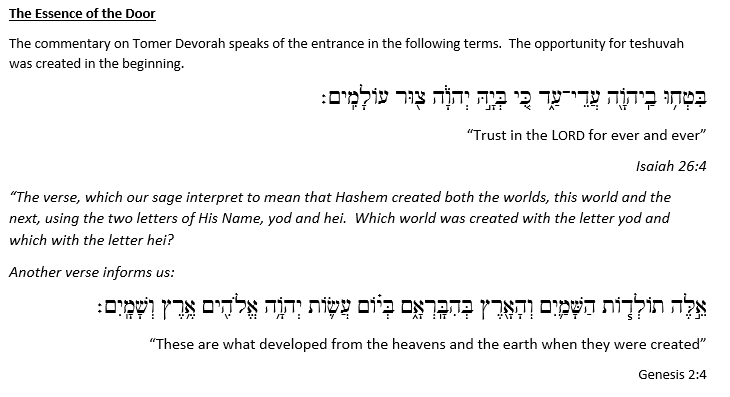
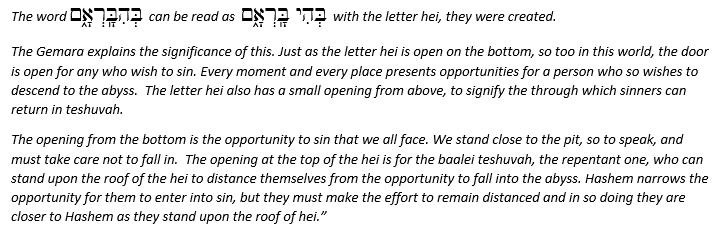
This perhaps explains the narrowness of the window at the top of the Ark which rescues Noach and his family. It is the same dimension as the Altar of Incense which represents the prayers of the people which ascend to “heaven”.
The narrow opening allows the light in but does not allow a view of all the destruction around whilst the cleansing takes place. The focus is on the world to come, which is revealed when the door opens. From this point the world can be remade.
King Yeshua speaks in similar terms:
Honour your father and mother, and, You shall love your neighbour as yourself.” The young man said to him, “All these I have kept. What do I still lack?” Yeshua said to him, “If you would be perfect, go, sell what you possess and give to the poor, and you will have treasure in heaven; and come, follow me.” When the young man heard this he went away sorrowful, for he had great possessions. And Yeshua said to his disciples, “Truly, I say to you, only with difficulty will a rich person enter the kingdom of heaven. Again I tell you, it is easier for a camel to go through the eye of a needle than for a rich person to enter the kingdom of God.” When the disciples heard this, they were greatly astonished, saying, “Who then can be saved?” But Yeshua looked at them and said, “With man this is impossible, but with God all things are possible.” Matthew 19:19-26
At the heart of this account, there is a question. Are we being told to sell everything to follow Messiah? Maybe?
What I believe we are being asked to do is to not allow any material thing in this world to become more important than the Kingdom of Heaven as it only cause us to look down at the abyss and potentially pull us over the edge.
This world was created for us to enjoy by the Creator, the Architect who was there at the very beginning and created not only the physical attributes of this beautiful world but also the access for us to return if we messed it up has desired us to be delighted in Him and with each other.
Our task is to understand and recognise that we are seeking to look beyond what is immediately before us in the knowledge that through His mercy He will allow teshuvah in whatever form that takes in acknowledgement of the provision He has made through King Yeshua.
Alternatively, amon means “artisan.” The Torah is saying, “I was the artisan’s tool of Hashem.” In the way of the world, a king of flesh and blood who builds a castle does not do so from his own knowledge, but rather from the knowledge of an architect, and the architect does not build it from his own knowledge, but rather he has scrolls and books in order to know how to make rooms and doorways. So too Hashem gazed into the Torah and created the world. Similarly, the Torah says, “Through the reishis Hashem created [the heavens and the earth],” and reishis means Torah, as in “Hashem made me [the Torah] the beginning (reishis) of His way” (Mishlei 8:22). Midrash Rabbah Bereshit
And, “You, Lord, laid the foundation of the earth in the beginning, and the heavens are the work of your hands; they will perish, but you remain; they will all wear out like a garment, like a robe you will roll them up, like a garment they will be changed. But you are the same, and your years will have no end.” And to which of the angels has he ever said, “Sit at my right hand until I make your enemies a footstool for your feet”? Are they not all ministering spirits sent out to serve for the sake of those who are to inherit salvation? Hebrews 1:10-14
But Yeshua deserves more honour than Moshe, just as the builder of the house deserves more honour than the house. For every house is built by someone, but the one who built everything is God. Also, Moshe was faithful in all God’s house, as a servant giving witness to things God would divulge later. But the Messiah, as Son, was faithful over God’s house. And we are that house of his, provided we hold firmly to the courage and confidence inspired by what we hope for. Hebrews 3:3-6
 MBM UK Family