Who is a God like you, pardoning iniquity and passing over transgression for the remnant of his inheritance? He does not retain his anger forever, because he delights in steadfast love. He will again have compassion on us; he will tread our iniquities underfoot. You will cast all our sins into the depths of the sea. You will show faithfulness to Jacob and steadfast love to Abraham, as you have sworn to our fathers from the days of old.
(Micah 7:18-20)
The Second Attribute – He Bears Sin
As we can see from the passage above, the ESV translates this as “pardoning iniquity”, and this is most likely influenced by the Christian understanding and influence of the crucifixion. Although this is not entirely misplaced, the emphasis on “pardoning” is in some ways unhelpful because (in my opinion) it diminishes the extent of the mercy of the Holy One, seemingly allowing inappropriate actions to take place without consequence. The root word here is “nasah” – to lift up – suffer or bear. The definition is set out below:
H5375 – נָסָה נָשָׂא – nâśâ’ nâsâh – naw-saw’, naw-saw’
A primitive root; to lift, in a great variety of applications, literally and figuratively, absolutely and relatively: – accept, advance, arise, (able to, [armour], suffer to) bear (-er, up), bring (forth), burn, carry (away), cast, contain, desire, ease, exact, exalt (self), extol, fetch, forgive, furnish, further, give, go on, help, high, hold up, honourable (+ man), lade, lay, lift (self) up, lofty, marry, magnify, X needs, obtain, pardon, raise (up), receive, regard, respect, set (up), spare, stir up, + swear, take (away, up), X utterly, wear, yield. Total KJV occurrences: 653
If the ESV had translated this as “bearing iniquity” then the implications of our actions have much greater consequences as they imply even greater compassion and mercy on the part of Messiah and The Holy One, and for us to realise that we are still answerable for our “avon” “iniquity”; that He is “bearing it” in the hope that we turn away from these bad actions.
If the teaching of Christianity is that our sins are forgiven and that there is no consequence; this being the worst kind of interpretation/misunderstanding of the crucifixion, then consequently, a belief is encouraged that we can get away with anything by saying a few penitent prayers. That is not what the scripture teaches.
The fact is that iniquity always costs someone something, and that someone will always bear that cost, whether it be a diminishment of resources, lifespan or some other psychological impact that then effects their performance in the physical.
If we are to desire to emulate Our Father the principle at work is how we take responsibility for others but not so that they can escape their obligations to themselves and society in general.
There is room for misunderstanding in this:
- The person we seek to assist might be verging on narcissism and sociopathy if we are always “picking up for them” encouraging them to only think about themselves to the complete exclusion of those around them.
- When someone has reached that level of self-aggrandisement or self-delusion, there may only be one solution. “Do not give dogs what is holy, and do not throw your pearls before pigs, lest they trample them underfoot and turn to attack you. Matthew 7:6
- Alternatively, the perception of the individual(s) might be influenced by social engineering (groupthink) or just some other external influence (drugs, alcohol, medications, personal trauma). It is how they continue to operate that call into question the efficacy of any regret or repentance.
Whatever the cause, at the heart of the question is whether there is still capacity for that person to make teshuvah/repentance and to turn away from their present condition despite what they may have done while in the state of sin that may have caused them to commit the acts that they have.
The passage below from Genesis 4:6-13 is key to us understanding the phrase “He bears sin”. The scene painted is one of the most profound as it really is the acting out of the consequence of the “two” trees in the Garden of Eden.
Abel, the younger brother of Kain brings a sacrifice before GOD. The issue is not whether the sacrifice was one of “blood” – the lamb, or of “grain” – the fruit of the ground. Within the sacrificial system, both are acceptable in their own right. The issue is the “tree” mindset.
Abel’s offering is one that is akin to the Tree of Life, an appreciation of the goodness of the Creator; acknowledgment that all things come from the hand of the Creator. We are not told in the text why Abel’s sacrifice was acceptable and Kain’s was not. The difference is hidden from us, but at the heart of Kain’s problem is jealousy of acceptance which leads to the outcome of anger and manslaughter. I use this term specifically as murder in Torah terms carries the death penalty. But that punishment is not meted out against Kain, therefore it must be manslaughter. The word “killed” is used, but not “manslaughter”.
Of the many explanations of the two trees, the following is one of the aspects.
A religious spirit: the ability to know the difference between the knowledge of good and evil does not actually serve us well in the kingdom relationship, because that knowledge was never something that would help to grow us, in fact it would only bring death.
This in part is what makes the idea of the Torah being called a Tree of Life so interesting.
She is a tree of life to those who lay hold of her; those who hold her fast are called blessed.
Proverbs 3:18
To know Good and Evil, brings us into a knowing that causes us to judge without truly seeing. Torah is designed to help us see beyond Good and Evil because it is wisdom. Knowledge of Good and Evil can bring a cold judgmental logic to a matter, but wisdom brings life to the decision.
“Judge not, that you be not judged. For with the judgment, you pronounce you will be judged, and with the measure you use it will be measured to you. Why do you see the speck that is in your brother’s eye, but do not notice the log that is in your own eye? Or how can you say to your brother, ‘Let me take the speck out of your eye,’ when there is the log in your own eye? You hypocrite, first take the log out of your own eye, and then you will see clearly to take the speck out of your brother’s eye. Matthew 7:1-5
We establish the outcome of sin upon a false temporal platform without knowing the heart of the Father. Clearly the Torah sets out consequences for judgment in this world; end of life consequences, that are a result of not attributing a full responsibility before Our Heavenly King.
Therefore, you have no excuse, O man, every one of you who judges. For in passing judgment on another you condemn yourself, because you, the judge, practice the very same things. We know that the judgment of God rightly falls on those who practice such things. Do you suppose, O man—you who judge those who practice such things and yet do them yourself—that you will escape the judgment of God? Or do you presume on the riches of his kindness and forbearance and patience, not knowing that God’s kindness is meant to lead you to repentance? Romans 2:1-4
Kain’s example to us is that as we are each faced the choice to turn away from “sin”, we turn away from the possibility of murder, whether that be death to ourselves (just one last doughnut!) or a piece of our soul dies off because we have strengthened another bit of our fleshly selves reinforcing the false aspect of our nature, or to others in both a physical and metaphorical sense. The retribution that the world seems to carry out (or not) is murderous to our souls as well as our bodies.
But the religious spirit of the Tree of Knowledge of Good and Evil does not give space for the Spirit of Life. As you read this, think about it, it takes time for us to fully grip this concept.
So let us return to Kain. The clue is the moment that GOD spoke to Kain. Although shepherding is not easy, it is much easier to grow sheep than to be a tiller the ground, which was Kain’s role.
Again, the issue is not the difficulty or the misunderstanding that the ground was cursed. The issue is the spirit of the offering. Kain’s offering was more Tree of Knowledge of Good and Evil, then Tree of Life.
Lift up your head
Adonai said to Kayin, “Why are you angry? Why so downcast? If you are doing what is good, shouldn’t you hold your head high? And if you don’t do what is good, sin is crouching at the door — it wants you, but you can rule over it.” Genesis 4:6-7
Sin always seeks to devour us, but the Holy One always desire for His children to rise above the issue – literally to “lift their head or lift their eyes”. Kain is no different. Unfortunately, he doesn’t and the consequences are such that his punishment causes him to cry to the Father.
Kayin said to Adonai, “My punishment is greater than I can bear. Genesis 4:13
This is where we see a wonderful link with the Micah passage and our phrase “He Bears Sin”.
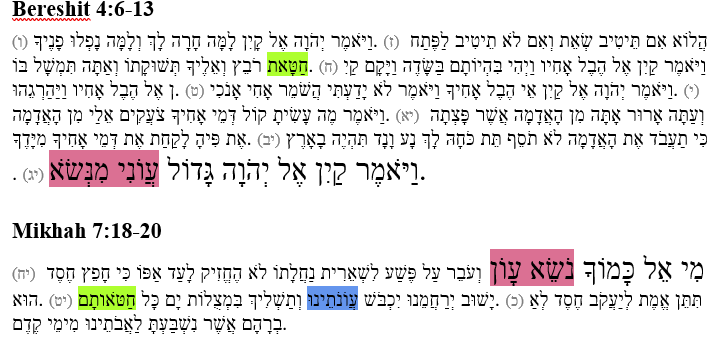
In the passage in Genesis, Kain says “My iniquity is greater than I can bear”
In the Micah passage, the phrase is reversed where it says “He bears our iniquity”
Surely he has borne our griefs and carried our sorrows; yet we esteemed him stricken, smitten by God, and afflicted. But he was pierced for our transgressions; he was crushed for our iniquities; upon him was the chastisement that brought us peace, and with his wounds we are healed. All we like sheep have gone astray; we have turned—every one—to his own way; and the LORD has laid on him the iniquity of us all. Isaiah 53:4-6
He Bears Iniquity
At the core of this is a principle of what we cause the Father to bear because of our refusal to repent. Or, what we have to bear because of our fellow travellers who the Father bears first, and therefore, we have to bear with just as He does in order to bring about the essence of His Kingdom on Earth.
This is a further example of the call in the Sermon on the Mount.
You therefore must be perfect, as your heavenly Father is perfect. Matthew 5:48
G5055 – τελέω – teleō – tel-eh’-o
From G5056; to end, that is, complete, execute, conclude, discharge (a debt): – accomplish, make an end, expire, fill up, finish, go over, pay, perform. Total KJV occurrences: 26
When Yeshua had received the sour wine, he said, “It is finished,” and he bowed his head and gave up his spirit. John 19:30
G5046 – τέλειος – teleios/tel’-i-os
From G5056; complete (in various applications of labor, growth, mental and moral character, etc.); neuter (as noun, with G3588) completeness: – of full age, man, perfect.
Total KJV occurrences: 19
Exercise
Q1. In the context of present-day circumstances, how are we to exercise the principles behind “He bears inquity”?
Q2. What are our daily situations where we are being called upon to “bear with others” and how do we react?
Q3. What difference does it make to you knowing that your “iniquity” is being carried by the Father and His Messiah?
Q4. What are you doing to perfect your self and to reduce the burden upon the Father and others around you?
Q5. Consider the following statement by Paul. How are you seeking to complete this exhortation on a daily basis? Write down two areas practical areas in your life where you could change with the Father’s help.
I appeal to you therefore, brothers, by the mercies of God, to present your bodies as a living sacrifice, holy and acceptable to God, which is your spiritual worship. Do not be conformed to this world, but be transformed by the renewal of your mind, that by testing you may discern what is the will of God, what is good and acceptable and perfect. Romans 12:1-2
 MBM UK Family