I don’t think that I am alone when I say that as a child, I spent a great deal of time either dreaming that I was a superhero or wishing that I had superpowers. Maybe it was the sign of a troubled childhood and was an expression of a desire to be able to escape my environment and also be able to exact some kind of revenge upon those around me who I felt were less than pleasant. All you amateur and professional psychologists out there can have a field day on this opportunity for analysis. Up front I would say that you are not entirely wrong if you conclude that all was not completely well at the farm.
Since the introduction of stories from way back when, there has always been this desire to move beyond ourselves. To be better, stronger, faster, richer, more attractive and the stories, whether written on the page or related orally or pictorially have attempted to convey a world that gives hope. Whether that ideal has been epitomised in one person or a civilisation, either fully human, demi-god or just god, there is something in us that wants things to be better and to give hope. When the chips are down, we really want someone or something to come and invade our world and take us out of the circumstances we are in.
In our modern world, this is no different. We may have projected this in a different way since the enlightenment in that the personification of hope has moved away from the more ethereal to the rather tangible material ideal, but we still yearn of the same utopian ideal that makes the world better. For many that can be summed up in the developments that we see in technology. I have a bit of a problem with this particular solution. Maybe it is because most futurologists seem to predict that this technological utopia will actual end up being the end of us as the introduction of artificial intelligence begins to learn at such an exponential rate that it soon realises how floored we are and decides of its own volition that we are the problem and that the world is a better place without us. That may be true to some extent, but it denies the possibility that the world was created for us to live in and enjoy, but not to own.
We are custodians. We are meant to be the stewards of our environment awaiting the return of the true landowner. This is both reassuring and daunting all at the same time. If we are only the stewards, then when the owner returns, what will they find, and will they be pleased about the way we kept their property? That is the daunting prospect. The reassuring part is that if there is an owner over and above our “paygrade” who wants us to enjoy the bounty of his provision, then there is a strong possibility that he is not going to allow us to be wiped out, even by our own standards of idiocy. After all he owns it all, us included.
Then we have the idea of the “civilisation” that is far more advanced than our own, benevolently looking in on us from the outside and waiting to intervene at the opportune moment so that we do not wipe ourselves out. Remember the 1950’s film “The day the earth stood still” starring Michael Rennie. Just post WWII and with the proliferation of atomic weapons, the science fiction classic captured the mood of the day and still conveys much of what we are experiencing in our modern society. C.S. Lewis, in his less popular than Narnia series, also captured a great deal of what we see presently in the third book of his science fiction trilogy “That Hideous Strength”. It even has an organisation called N.I.C.E. A scientific and medical community who existed way before the UK’s National Institute for Clinical Excellence, but in light of the COVID 19 pandemic, eerily accurate in some of its portrayal of how we see government and media in cahoots with each other as they seek to convince the population of how bad or necessary things are in order for us to make it out of the other side.
So what has all this got to do with superheroes?
Well, it seems to me that even with all our sophistication, our appetite for heroes and superheroes who can bring a rescue to us is greater than it ever has been. Maybe it is the ability of the filmmakers, who through the wonders of technology and the green screen have managed to create a world which allows the gods and heroes of Marvel and DC to name but two, to come to life in such a way that we can immerse ourselves in their reality, even though we may have seen New York or some other capital, fictional or otherwise, be destroyed while innocent onlookers run and scream and try to hide from the impending doom that always seems to result from the unveiling of the hidden hero in their midst.
I recently saw this slogan emblazoned on a building next to a local bakery.
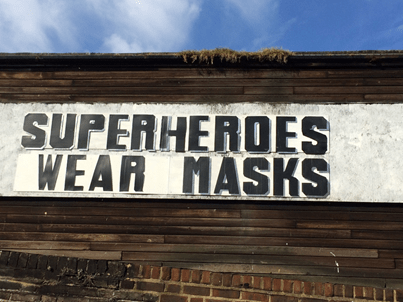
In this instance this was referring to the fact that we have all been instructed to wear masks to protect each other during the pandemic and as time has gone on this has become more and more controversial. Why? Because, it is not just superheroes who wear masks; it is supervillains too! In fact we all wear masks in one way or another. Whether it be the mask of virtue so that we can achieve some high office, which once achieved can be discarded, thereby revealing the true intent behind the rhetoric. Or masks of protection, ensuring that we are not giving the unfettered truth in order to protect the ones that we love.
There is a mask that has been worn by “one” for the last nearly six thousand years, by the Hebrew calendar, who from time to time has made an appearance overtly, but covertly has revealed himself on a daily basis. By the reckoning of the Gregorian calendar, this same “one” made an appearance around two thousand years ago, masked so perfectly, that those who thought they would recognise him when he appeared completely missed it.
Rabbi Yoḥanan says: If you saw a generation whose wisdom and Torah study is steadily diminishing, await the coming of the Messiah, as it is stated: “And the afflicted people You will redeem” (II Samuel 22:28). Rabbi Yoḥanan says: If you saw a generation whose troubles inundate it like a river, await the coming of the Messiah, as it is stated: “When distress will come like a river that the breath of the Lord drives” (Isaiah 59:19). And juxtaposed to it is the verse: “And a redeemer will come to Zion” (Isaiah 59:20). Talmud Sanhedrin 98a
Rabbi Alexandri says: Rabbi Yehoshua ben Levi raises a contradiction between two depictions of the coming of the Messiah. It is written: “There came with the clouds of heaven, one like unto a son of man…and there was given him dominion and glory and a kingdom…his dominion is an everlasting dominion” (Daniel 7:13–14). And it is written: “Behold, your king will come to you; he is just and victorious; lowly and riding upon a donkey and upon a colt, the foal of a donkey” (Zechariah 9:9). Rabbi Alexandri explains: If the Jewish people merit redemption, the Messiah will come in a miraculous manner with the clouds of heaven. If they do not merit redemption, the Messiah will come lowly and riding upon a donkey. (ibid)
Apropos the Messiah, the Gemara asks: What is his name? The school of Rabbi Sheila says: Shiloh is his name, as it is stated: “Until when Shiloh shall come” (Genesis 49:10). The school of Rabbi Yannai says: Yinnon is his name, as it is stated: “May his name endure forever; may his name continue [yinnon] as long as the sun; and may men bless themselves by him” (Psalms 72:17). The school of Rabbi Ḥanina says: Ḥanina is his name, as it is stated: “For I will show you no favor [ḥanina]” (Jeremiah 16:13). And some say that Menaḥem ben Ḥizkiyya is his name, as it is stated: “Because the comforter [menaḥem] that should relieve my soul is far from me” (Lamentations 1:16). And the Rabbis say: The leper of the house of Rabbi Yehuda HaNasi is his name, as it is stated: “Indeed our illnesses he did bear and our pains he endured; yet we did esteem him injured, stricken by God, and afflicted” (Isaiah 53:4). (ibid)
He made Him who knew no sin to be sin on our behalf, so that we might become the righteousness of God in Him. (2 Corinthians 5:21)
Each one of us has the ability to be a superhero. Our superpower is our humanity and our ability to choose to care for each other and for ourselves. If we don’t care for ourselves than it takes far more effort for us to be able to care for others. If we can be honest with ourselves and step away from the personal aggrandisement that we seek in the name of justice and human rights and humbly achieve these two simple things each day in our environment, whether it be home, work or some other context, we can become the superheroes who seek the well being of each other and in doing so will discover not only our ability to love but also the knowledge that we are loved far beyond anything that we could imagine for ourselves. Whether you agree with the idea of a Creator who dwells outside of our dimension but has the ability to step into it at any time they please or not, our day to day hope has to be based on our ability to be the superhero in the community around us, because that is truly how the world changes. It has always been this way. Our greatest superpower is LOVE and the ability to choose LIFE. We don’t need to be Superman to be heroes. Perhaps we can emulate to be Clark Kent and just be there when others need our help.
 MBM UK Family